The short answer: M-Shwari costs 9% for 30 days, Okoa Jahazi takes 10% before you even get the airtime, and Fuliza charges a small fee every single day. None of them looks expensive on its own. Used together and repeatedly, they quietly take a large share of your income.
Borrowing KES 100 for airtime, KES 500 on Fuliza or KES 3,000 on M-Shwari feels harmless. The fee is small, the money arrives instantly, and repayment happens automatically. That convenience is exactly why Safaricom loans are easy to keep using, and hard to stop. This guide shows what each one really costs, how they feed each other, and how to see where you stand.
Safaricom loan costs at a glance
| Loan | Main fee | Repay by | What catches people |
|---|---|---|---|
| M-Shwari | 7.5% facilitation fee + 20% excise on the fee = 9% | 30 days | Rolling over adds another fee on the unpaid balance |
| Fuliza | 1% access fee + daily fee (up to KES 25) + 20% excise on the daily fee | No fixed date; deposits repay it first | The daily fee keeps running until you clear it |
| Okoa Jahazi | 10% service fee, deducted upfront | 5 days, from your next top-ups | You repay the full amount but received 10% less |
M-Shwari: the 9% that repeats every month
M-Shwari is a 30-day loan with a 7.5% facilitation fee, not interest. NCBA's published terms add 1.5% excise duty, so the real cost is 9%.
Example: borrow KES 5,000. Fee: KES 375 + KES 75 excise = KES 450. You repay KES 5,450 within 30 days.
The trap is the rollover. If you cannot repay on time, the period is extended by 30 days and another 7.5% fee (plus excise) is charged on what is still unpaid. Miss the first deadline on that KES 5,000 and you have paid about KES 900 in fees for two months. NCBA's key facts also state that failing to settle within 120 days can lead to a negative CRB listing.
Try your own numbers in the M-Shwari loan cost calculator.
Fuliza: small daily fees that never pause
Fuliza charges a one-off 1% access fee, then a daily maintenance fee on the outstanding balance, with 20% excise on that daily fee. Safaricom revised the bands in 2026: small balances get a few fee-free days, while balances above KES 2,500 pay up to KES 25 a day. Our full breakdown is in Fuliza Charges 2026.
Example: a KES 5,000 Fuliza balance left for 30 days. Access fee KES 50, daily fees 30 × KES 25 = KES 750, excise on those fees KES 150. Total: about KES 950, or 19%, double the M-Shwari fee for the same month.
Fuliza is cheap when you clear it in a day or two. It becomes the most expensive of the three when a balance lingers. Because any M-PESA deposit repays Fuliza first, money you receive arrives already smaller. Check your own charges with the Fuliza calculator.
Okoa Jahazi: you repay more than you got
Okoa Jahazi advances airtime, and Safaricom charges a 10% service fee on each request. The fee is taken upfront, so you receive less than you asked for but owe the full amount. Your next top-ups are used to clear it, and you cannot borrow again until it is paid.
Example: request KES 100. You receive KES 90 of airtime and repay KES 100. That is 11% on what you actually got. Borrow like this once a week and you pay KES 40 a month for KES 360 of airtime.
Safaricom says a debt not cleared after 15 days can be recovered from your Bonga Points. Okoa Bundles and Auto Okoa carry the same 10% fee.
How the borrow-and-repay cycle traps you
Each loan is small. The damage comes from how they connect:
- Money arrives and repayments come first. Your deposit clears Fuliza automatically, and your top-up clears Okoa. You never feel the full amount in your hands.
- You run short again. With less usable money, the gap reopens within days. Fuliza covers a payment, or you request Okoa for airtime.
- Fees pile up. Each new loan carries a new fee, so you borrow more just to cover the cost of earlier borrowing.
- Loans start covering loans. An M-Shwari loan clears a big Fuliza balance, then M-Shwari itself needs rolling over.
Because the repayments are automatic and each fee is small, most people cannot say what they spent on loan costs last month. That blind spot is the real problem.
Here's what your M-PESA loan activity looks like inside Shmoney:
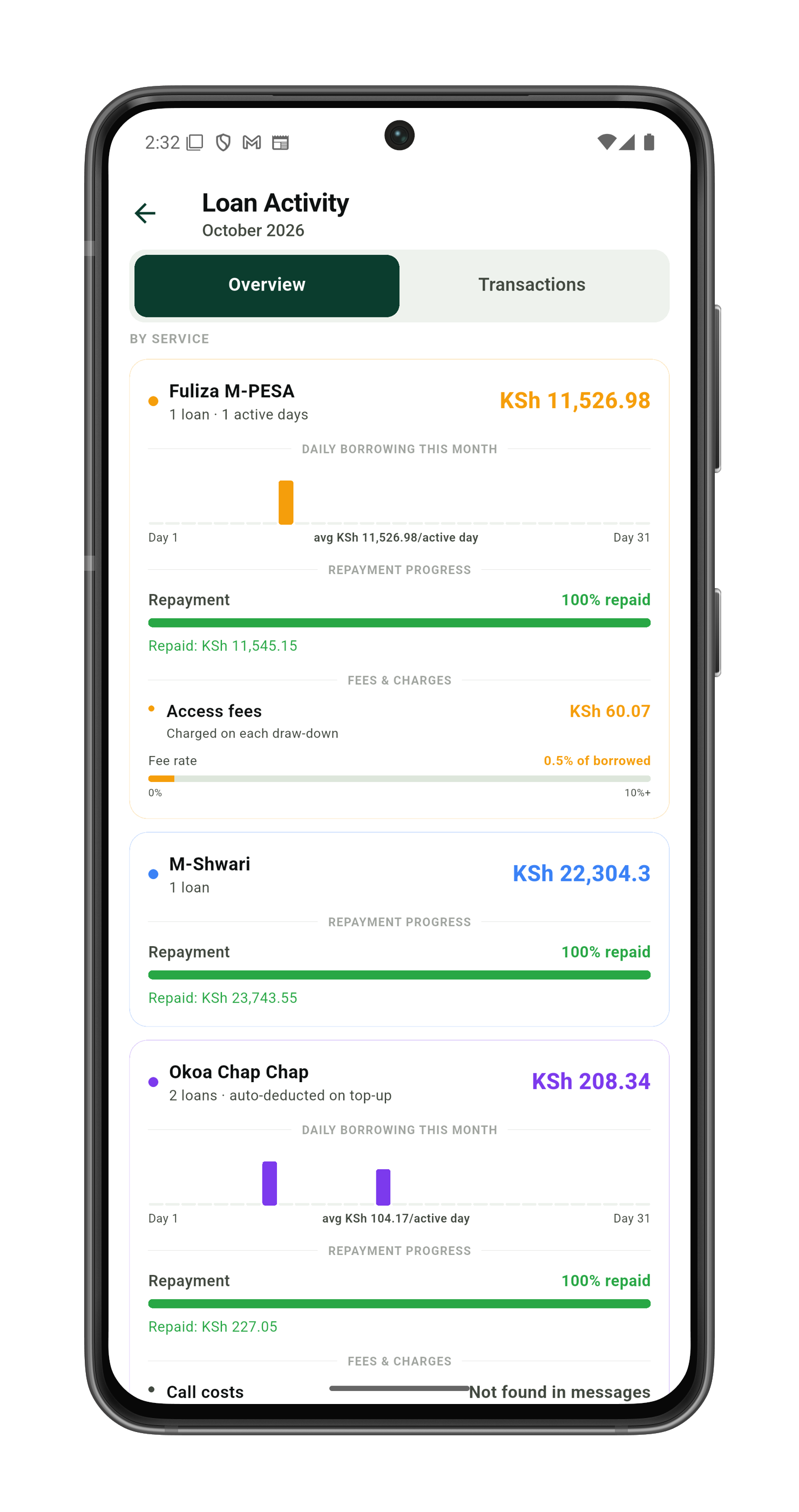
This is where Shmoney can help. Shmoney helps you track your M-PESA loan activity, including Fuliza, M-Shwari and Okoa-related transactions, and see the fees and repayments recorded in your M-PESA messages. Instead of relying on memory, you can review your borrowing activity and get a clearer picture of what loan fees are costing you.
Get Shmoney on Google Play (Android)
Signs you are already in the cycle
- Your Fuliza balance is rarely zero after payday.
- You request Okoa Jahazi every week or so.
- You have rolled over an M-Shwari loan, or taken one to clear another debt.
- You cannot name your total loan fees for the last 30 days.
How to break the cycle
- Find your real number. Add up access fees, daily fees, facilitation fees and Okoa fees from the last 30 days.
- Clear the most expensive debt first. That is usually the Fuliza balance that has been sitting for weeks.
- Build a small buffer. Even KES 200 set aside covers the gap that sends you to Okoa.
- Set a monthly cap on loan fees and watch it. If you stay under it for a few months, the habit changes.
Our guides on where your M-PESA money goes and why saving is hard in Kenya can help with the next steps.
See where your loans stand
Shmoney helps you review your M-PESA loan activity, repayments and fees in one place. See the charges reflected in your transaction messages, spot recurring borrowing patterns, and understand how much you are paying to access short-term money.
Download Shmoney on Google PlayFrequently asked questions
How much does an M-Shwari loan cost?9% for 30 days: a 7.5% facilitation fee plus 20% excise duty on that fee. A KES 5,000 loan costs KES 450, so you repay KES 5,450.
What happens if I can't repay M-Shwari in 30 days?The period is extended by 30 days and another 7.5% fee (plus excise) is charged on the unpaid balance. Settling late for 120 days can lead to a negative CRB listing.
How much does Okoa Jahazi charge?10% on each request, deducted upfront. Request KES 100, receive KES 90, repay KES 100 from your next top-ups.
Is Fuliza cheaper than M-Shwari?For a day or two, usually yes. If a balance stays open for weeks, the daily fees can exceed M-Shwari's single 9% fee.
How can I track what Safaricom loans cost me?You can add up the fees in your M-PESA messages yourself, or use Shmoney to review loan activity, repayments and fees reflected in those messages in one place. See also how to get your M-PESA statement and the full M-PESA charges guide.
Sources: Safaricom M-Shwari FAQs, NCBA M-Shwari key facts, Safaricom Okoa Jahazi terms, Auto Okoa terms. Figures are estimates and tariffs can change; confirm with Safaricom before borrowing. Shmoney is not affiliated with Safaricom or NCBA.