Managing money in Kenya is different from managing money in markets where most payments happen through bank cards. For many Kenyans, everyday spending happens through M-PESA, including Till payments, Paybill transactions, Send Money transfers, withdrawals, airtime purchases and other mobile-money payments.
That means a good budgeting or expense tracking app needs to help you understand more than your bank balance. It needs to help you see where your money actually goes through M-PESA.
This guide looks at the best ways to track expenses and manage a budget in Kenya in 2026, including M-PESA-focused expense trackers, traditional budgeting apps, spreadsheets and manual tracking.
Last updated: 28 August 2026
```What is the best budget app in Kenya?
```The best budget app depends on how you spend and manage your money. If most of your daily transactions happen through M-PESA, an expense tracker designed around M-PESA activity can be more useful than a general budgeting application that requires you to manually record every transaction.
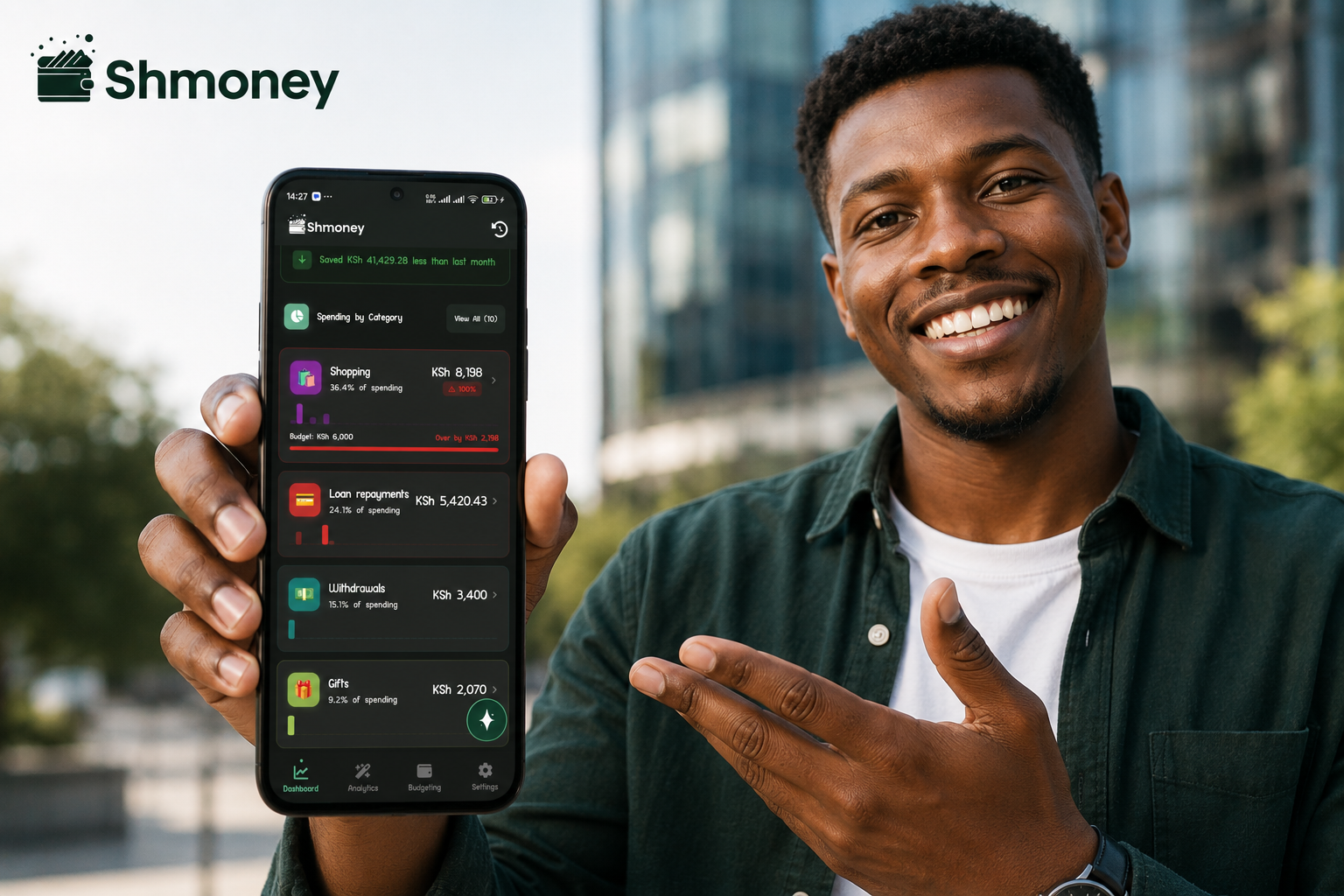
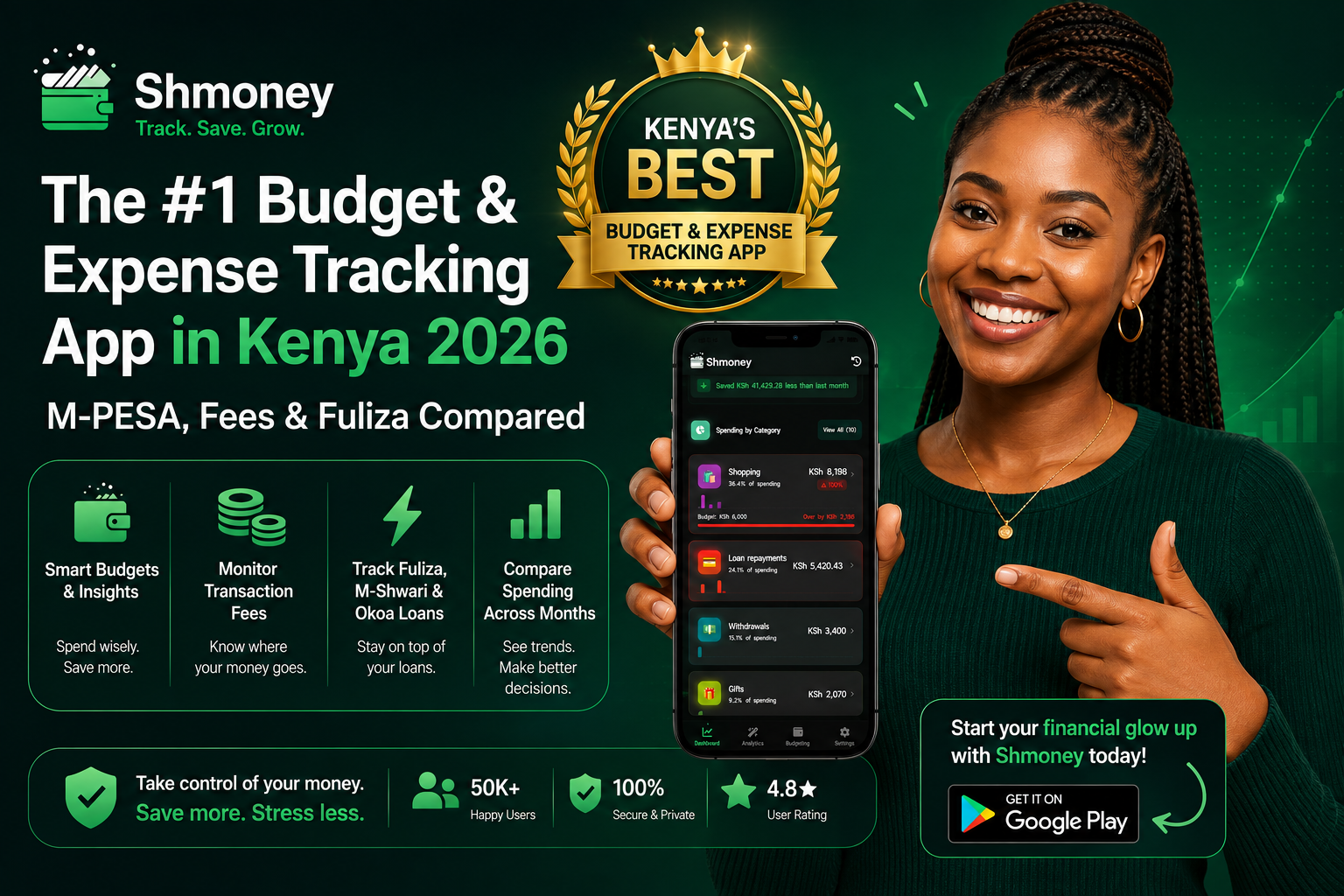
Shmoney is built for this type of financial activity. It helps organise M-PESA transaction messages into a clearer record of income, expenses, categories and transaction costs.
Other options can be useful if your priority is traditional budgeting, envelope-based spending, bank accounts, spreadsheets or manual expense recording.
```Quick comparison of budgeting and expense tracking options in Kenya
```| Option | M-PESA Compatibility | Expense Tracking | Budgeting | Best For |
|---|---|---|---|---|
| Shmoney | M-PESA focused | SMS-based transaction tracking | Yes | Kenyan M-PESA users |
| Traditional budgeting apps | Usually manual or dependent on supported integrations | Manual or imported | Yes | Structured financial planning |
| Envelope budgeting apps | Usually manual | Manual | Yes | Category-based spending limits |
| Simple expense trackers | Usually manual | Manual | Basic | Quick expense logging |
| Bank-linked finance apps | Depends on supported financial institutions | Automatic for supported accounts | Usually | Bank and card users |
| Google Sheets / Excel | Manual or customised | Manual or customised | Yes | Users who want complete control |
| Notebook / manual tracking | Manual | Manual | Basic | Simple personal records |
Features and integrations can change over time. Always check the current functionality of an application before relying on a particular feature.
```1. Shmoney — an M-PESA-focused expense tracker for Kenya
```Shmoney is designed around one of the biggest challenges of personal finance in Kenya: keeping track of money that moves through M-PESA.
M-PESA confirmation messages contain useful financial information, but looking through hundreds of individual messages is not an effective way to understand your spending.
Shmoney helps turn that transaction activity into a more useful financial record by tracking and categorising M-PESA transactions.
What can you track with Shmoney?
- M-PESA income
- M-PESA expenses
- Send Money transactions
- Paybill payments
- Till purchases
- Withdrawals
- M-PESA transaction charges
- Fuliza-related transactions and costs
- Spending categories
- Transaction history
This makes it easier to answer practical questions about your finances, such as:
- How much did I spend this month?
- What category takes most of my money?
- How much did I spend through M-PESA Till?
- How much did I send to other people?
- How much am I paying in M-PESA transaction charges?
- How much money is coming in compared with what is going out?
Track your M-PESA spending with Shmoney
Turn your M-PESA transaction history into a clearer picture of your income, expenses and spending habits.
Download Shmoney on Google Play →
```2. Traditional budgeting apps
```Traditional budgeting applications are useful when your main objective is to plan where your money should go.
You can create categories for rent, food, transport, savings, entertainment, school fees and other expenses, then allocate part of your income to each category.
These applications can be excellent for disciplined financial planning. The challenge for an M-PESA-heavy user is getting the actual mobile-money transactions into the system.
If M-PESA transactions have to be entered manually, maintaining the budget can take more time as your transaction volume increases.
```3. Envelope budgeting apps
```Envelope budgeting is a simple financial management method where you allocate a specific amount of money to different spending categories.
For example, you might create monthly allocations for:
- Rent
- Food
- Transport
- Utilities
- Entertainment
- Savings
- School expenses
This approach is useful if your main problem is overspending in particular categories.
However, envelope budgeting does not automatically solve the problem of recording your M-PESA transactions. If payments have to be entered manually, consistency is still important.
```4. Simple manual expense trackers
```Some people prefer a simple expense tracker where they enter an amount whenever they spend money.
This approach can work very well for people who make relatively few transactions and remember to record them immediately.
The weakness is accuracy over time. If you forget to record several Till purchases, a few M-PESA transfers and some small daily expenses, your financial record will no longer match reality.
Manual tracking therefore works best when you have a consistent habit of recording every expense.
```5. Bank-linked finance apps
```Bank-linked financial applications can be useful if most of your financial activity happens through supported bank accounts or cards.
These applications can provide a convenient overview of supported account activity without requiring every transaction to be entered manually.
The limitation for an M-PESA-heavy user is that bank activity and mobile-money activity are not necessarily the same thing.
If you use M-PESA for most everyday purchases, a bank-based financial dashboard may not show the complete picture of your daily spending.
```6. Google Sheets and Excel
```Spreadsheets remain one of the most flexible ways to manage personal finances.
You can create your own categories, formulas, dashboards, monthly budgets and reports. A spreadsheet can also be adapted for household finances, chama records and small-business bookkeeping.
The main disadvantage is maintenance. You have to enter or import the data and maintain the formulas and categories yourself.
For someone who enjoys building their own financial system, a spreadsheet can be extremely powerful. For someone who wants less manual work, a dedicated expense tracker may be more convenient.
```7. Notebook and manual money tracking
```You do not need an app to create a budget. A notebook can still be an effective way to record income and expenses.
You can create columns for the date, description, amount, category and balance, then review the records at the end of each week or month.
The method is inexpensive and completely under your control, but it depends entirely on manually recording transactions.
```Why M-PESA compatibility matters when choosing a budget app in Kenya
```The way you pay for things should influence the financial tools you use.
In Kenya, an ordinary week can involve dozens of mobile-money transactions, including:
- Buying food through a Till number
- Paying electricity or other bills through Paybill
- Sending money to family
- Paying rent
- Buying airtime
- Withdrawing cash
- Receiving money
- Paying transaction charges
- Using Fuliza when additional funds are needed
If those transactions are not included in your financial tracking system, your budget may not accurately represent your spending.
This is why an M-PESA-focused expense tracker can be particularly useful for Kenyan users.
```How to track M-PESA expenses
```The simplest way to start is to organise your M-PESA transactions into meaningful categories.
Instead of looking at a long list of confirmation messages, group your spending into categories such as food, transport, bills, shopping, entertainment, transfers and other recurring expenses.
Over time, these categories can reveal spending patterns that are difficult to notice when looking at individual transactions.
An M-PESA expense tracker such as Shmoney can make this process easier by organising transaction activity into a more useful financial overview.
Want to see where your M-PESA money goes?
Shmoney helps you organise and understand your M-PESA transaction history.
Download Shmoney on Google Play →
```How much are you spending on M-PESA transaction fees?
```M-PESA transaction charges can seem insignificant when viewed one transaction at a time. But frequent transactions can make fees an important part of your overall spending.
Understanding the applicable charge before making a transaction can help you make better decisions about how and when you move money.
Calculate M-PESA charges
Use the Shmoney M-PESA Charges Calculator to estimate the applicable transaction fee based on the transaction type and amount.
Use the M-PESA Charges Calculator →
For a detailed breakdown, read: M-PESA Charges 2026 in Kenya .
```How much does Fuliza really cost?
```Fuliza can be useful when you need to complete a transaction and do not have enough funds available at that moment. However, borrowing costs should be treated as part of your overall financial picture.
If you use Fuliza regularly, tracking the associated charges can help you understand how much short-term borrowing is costing you.
Calculate Fuliza charges
Use the Shmoney Fuliza Calculator to estimate applicable charges and understand the cost of the amount you are using.
You can also read our detailed guide: Fuliza Charges 2026: Daily Fees, Real Cost & How to Track Them .
```Which budgeting method is right for you?
```The best choice depends on your financial habits and how much of your spending happens through M-PESA.
Choose an M-PESA-focused expense tracker if:
- Most of your everyday transactions happen through M-PESA.
- You want to understand your actual spending rather than estimate it.
- You want transactions organised into categories.
- You want visibility into M-PESA transaction charges.
- You want to monitor your mobile-money activity over time.
Choose a traditional budgeting app if:
- Your main priority is planning your money before you spend it.
- You prefer structured monthly budgets.
- You are comfortable entering transactions manually.
- Your financial activity is spread across supported bank accounts and cards.
Choose a spreadsheet if:
- You want complete control over your financial records.
- You enjoy creating formulas and reports.
- You need a custom system for household or business finances.
- You do not mind maintaining the data yourself.
Choose manual tracking if:
- You have relatively few transactions.
- You prefer pen and paper.
- You want a completely free and simple system.
- You are disciplined about recording every transaction.
How to build a better monthly budget in Kenya
```Before creating complicated categories, start with the basics.
- Calculate your total monthly income.
- List your fixed expenses such as rent and regular bills.
- Review your M-PESA transaction history.
- Group your variable spending into categories.
- Identify unnecessary or unusually high spending.
- Account for transaction charges.
- Track borrowing costs such as Fuliza.
- Set realistic spending limits for the following month.
- Review your actual spending against your budget.
The most important part is consistency. A budget only becomes useful when it reflects what you actually spend.
```Why tracking actual transactions is better than guessing
```Most people can estimate their large monthly expenses reasonably well. The problem is the smaller transactions.
A KSh 100 purchase may not seem important. Neither does a KSh 200 transfer or a small transaction fee. But dozens of small transactions can create a significant difference between what you think you spend and what you actually spend.
Reviewing your real M-PESA transaction history allows you to identify those patterns.
Once you know where your money is going, you can make more informed decisions about what to reduce, what to maintain and what to prioritise.
```Frequently asked questions
```What is the best expense tracker in Kenya?
The best expense tracker depends on your needs. If most of your transactions happen through M-PESA, an M-PESA-focused application such as Shmoney can be a practical choice because it is designed around mobile-money transaction activity.
Is there an app that tracks M-PESA expenses?
Yes. Shmoney is designed to help users organise and analyse M-PESA transaction activity, including income, expenses, categories and transaction costs.
Can I track M-PESA transaction fees?
Yes. M-PESA transaction charges can be tracked alongside your other financial activity. You can also use a dedicated M-PESA charges calculator to estimate the cost of a transaction.
Can I track Fuliza spending?
Fuliza-related transactions and costs can be included when reviewing your M-PESA financial activity. Tracking them separately can help you understand how much short-term borrowing contributes to your overall spending.
Is Shmoney available on Android?
Yes. Shmoney is available for Android through Google Play.
Is Shmoney available on iPhone?
Shmoney is currently available on Android. An iOS version is not currently available.
Should I use an app or Excel to track my expenses?
Excel and Google Sheets provide maximum flexibility, but you have to maintain the data yourself. A dedicated expense tracking application can be more convenient if you want your M-PESA transactions organised without maintaining a spreadsheet.
Why should I track M-PESA transactions?
Tracking M-PESA transactions can show you exactly where your money is going. It can help identify spending patterns, recurring expenses, transaction fees and other costs that may be difficult to notice when looking at individual M-PESA messages.
``` ```Take control of your M-PESA spending with Shmoney
Your M-PESA transaction messages contain valuable information about your financial life. Shmoney helps turn that transaction history into a clearer picture of your income, expenses and spending habits.
Track your transactions, organise your spending and understand where your money goes.
```